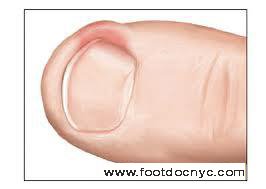
Hammer toe, claw toe, mallet
toe
Hammertoes occur when the smaller toes
of the foot become bent and prominent. The four smaller toes of
the foot are much like the same fingers in the hand. Each has
three bones (phalanges) which have joints between them (interphalangeal
joints). The toes form a joint with the long bones of the foot
(metatarsals) and it is this area that is often referred to as
the ball of the foot.
Normally, these bones and joints are
straight. A hammertoe occurs when the toes become bent making
the toe prominent. This can affect any number of the lesser
toes. In some cases, a bursa (rather like a deep blister) is
formed over the joint and this can become inflamed (bursitis).
With time, hard skin (callous) or corns (condensed areas of
callous) can form over the joints or at the tip of the toe.
What
causes hammertoes?
There are many different causes but
commonly it is due to shoes or the way in which the foot works
(functions) during walking. If the foot is too mobile and / or
the tendons that control toe movement are over active, this
causes increased pull on the toes which may result in deformity.
In some instances trauma (either direct
injury or overuse from walking or sport) can predispose to
hammertoes. Patients who have other conditions such as diabetes,
rheumatoid arthritis and neuromuscular conditions are more
likely to develop hammertoes.
Are women more likely to get the
problem?
It is more common in women as they tend
to wear tighter, narrower shoes with increased heel height.
These shoes place a lot of pressure onto the joint and
predispose to deformity. It is common for patients to wear shoes
that are too small and this can predispose to the problem.
Will it get worse?
At the start of the deformity, it is
generally mobile which means that the toe can be straightened.
However, with time, the joint become fixed or rigid. This can
then affect the joint at the ball of the foot and, in severe
cases, the joint capsule ruptures (tears) so that the joint
becomes dislocated and the toe sits up in the air.
What are the common symptoms?
- Deformity / prominence of toe
- Pain
- Redness around the joints
- Swelling around the joints
- Corn / Callous
- Difficulty in shoes with deformity
of the shoe upper
- Difficulty in walking
- Stiffness in the joints of the toe
How is it recognized?
Clinical examination and a detailed
history allow diagnosis. X-rays are often not required but can
help to evaluate the extent of the deformity and the degree of
arthritis within the joint.
What can I do to reduce the pain?
There are several things that you can
do to try and relieve your symptoms:
- Wear good fitting shoes with a
deep toe box
- Avoid high heels
- Use a toe prop to straighten the
toe if it is still mobile
- Wear a protective pad over the toe
- See a podiatrist
What will a podiatrist do?
If simple measures do not reduce your
symptoms, there are other options:
- Advise appropriate shoes
- Advise exercises if the toes are
still mobile
- Show you how to strap the toe in a
corrected position
- Provide a splint or protection
- Consider prescribing orthotics
- Advise on surgery
The way in which your foot loads during
walking can place increased stress on the ball of the foot and
cause increased toe activity. Special shoe inserts (orthotics)
can help to control foot movement. Whilst these are unlikely to
resolve established deformity they may help reduce discomfort in
the ball of the foot.
Will this cure the problem?
If the deformity is mobile, then this
may help prevent progression although there have been no
scientific studies to analyse the benefit. If the deformity is
fixed, then orthotics will not cure the problem but may reduce
the associated symptoms.
What will happen if I leave this
alone?
Generally, the deformity becomes worse
with time and slowly becomes fixed (stiff). This can cause
discomfort in shoes. The position of the toe places increased
stress on the ball of the foot and this can become painful. Corn
and callous formation on the ball of the foot is not uncommon.
In some cases, the metatarsophalangeal joint capsule ruptures,
causing the toe to sit up in the air.
How can I cure the deformity?
The only effective way of correcting
the deformity is to have a surgical operation.
How does the operation correct the
deformity?
There are a number of different
operations. However, the most common operations are:
- Tendon transfer
- Digital arthroplasty
- Digital arthrodesis
Tendon transfers involve taking the
tendon from under your toe and re-routing it to the top of the
toe so that the toe is pulled down. This can be used alone if
the toe is mobile or in combination with the other two
procedures. This can leave the toe a bit swollen and stiff.
Digital arthroplasty and arthrodesis
involve the removal of bone from the bent joint to allow
correction. An arthroplasty removes half the joint and leaves
some mobility whilst an arthrodesis removes the whole joint and,
following a period of time with a wire/pin protruding from the
end of the toe, leaves the toe rigid.
In more severe cases, the tendon on the
top of the toe and the joint at the ball of the foot need to be
released to allow the toe to straighten. If there is severe
stiffness at this joint, then the base of the bone at the bottom
of the toe (phalanx) may need removing (basal phalangectomy) or
the metatarsal shortened (Weil osteotomy).
Is it painful?
The nature of surgery means that there
will be pain and swelling, usually worse the night after
surgery. However, with modern anesthetic techniques and pain
killers, this can be well controlled. The level of pain
experienced varies greatly from patient to patient with some
experiencing no significant discomfort.
Will I have to have a general
anesthetic (be asleep)?
Not if you did not want one. Many of
these procedures are performed perfectly safely under local
anaesthetic (you are awake). Some patients worry that they may
feel pain during the operation but it would not be possible to
perform the operation if this were the case.
Will I have to stay in hospital?
No. As long as you were medically fit
and have adequate home support, many patients are able to have
this type of operation performed as day surgery and go home.
Are there a lot of complications?
There are
risks and complications
with all operations and these should be discussed in detail with
your specialist. However, with most foot surgery it is important
to remember that you may be left with some pain and stiffness
and the deformity may reoccur in the future. This is why it is
not advisable to have surgery if the deformity is not painful
and does not limit your walking. A thorough examination of your
foot and general health is important so that these complications
can be minimized.
Although every effort is made to reduce
complications, these can occur. In addition to the general
complications that can occur with foot surgery, there are some
specific risks with toe surgery:
- Persistent swelling which may be
permanent
- Recurrence of deformity / corn
(this tends to be more of a problem with the little toe)
- Regrowth of removed bone
- Residual pain
- Stiffness or flail (floppy) toe
- The toe may not sit on the ground
– floating toe (there is an increased risk of this with
arthrodesis)
- You may get discomfort in other
parts of your foot during the recovery period. This
generally settles.
- There is always a possibility that
the deformity may return in later life.
- You may develop a
mallet toe
deformity in the long term
When will I be able to walk again and
wear shoes?
In the majority of cases, you will able
to walk with the aid of crutches within 2-4 days but you will
remain somewhat limited for the first 2 weeks. Some patients are able to return to
wider shoes within two weeks with 60% of patients in shoes at 6
weeks and 90% in 8 weeks. This period is longer for arthrodesis
as shoes cannot be worn until the wire/pin has been removed
(generally 3-6 weeks). Swelling generally starts to reduce at
6-8 weeks and the foot will be beginning to feel more normal at
3 months although the healing process continues for 1year.
***This material
is only provided as helpful information and
not as medical advice and you should consult
with your foot doctor or another medical
doctor for a professional diagnosis. ***
For more
information on athlete's foot treatments and
to make an appointment with the NY hammertoe Podiatrist Foot Doctor Surgeon, please
call our office today at (212)
288-3137 or
click here
to make an appointment.